| 1999 |
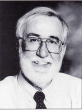 |
Sackett, David Lawrence
1934 |
Prof. Dr. med. Epidemiology, Universität, Oxford, England
The researcher, thought leader and contributor to the systematic evaluation of clinical research literature, whose methods facilitate the targeted translation of clinical research findings into everyday practice and clinical practice and improve the effectiveness and efficiency of the healthcare system |
| 1999 |
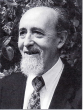 |
Carmeliet, Edward Emiel
1930 |
Prof. Dr. med. of Physiology University of Leuven, Belgium
With his contributions to the alteration of the electrical function of the heart during disturbances of energy metabolism and cardiac rhythm, he has built an important bridge between basic research and clinical medicine; for four decades he has been able, with great personal commitment and originality, to promote knowledge about the functioning of the molecules and ion movements whose complex interactions lead to the electrical excitation of the heart. |
1995 |
|
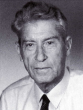
Nüscheler, Fritz
1919 - 1999 |
Dr. jur., Central Secretary of the Swiss Association for the Integration of the Disabled
To the far-sighted pioneer and co-designer of numerous rehabilitation institutions, who, as a selfless advocate for physically or intellectually disabled people, has tirelessly made significant contributions to improving their quality of life, their legal status and their economic situation. |
1993 |
|
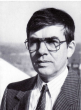
Mühlbauer, Roman C.
1943 |
Biology laboratory technician, employee of the Institute of Pathophysiology, University of Berne
To the promoter of the understanding of bone and calcium phosphate metabolism, in recognition of his own scientific contribution and his tireless commitment to communicating nutrition-oriented specialist knowledge to a broad public. |
1992 |
|
Meng, Walter
1915 - 1997 |
Dr. med., FMH specialist in surgery; President of the Inter-Association (IVR) for Rescue Services
To the pioneer of a modern rescue system in Switzerland, who, with outstanding expertise and based on his experience as a doctor in a large accident practice, with knowledge of the federal structure of the healthcare system and the difficulties of intercantonal regulations, significantly promoted the coordination of public and private rescue services through standardized guidelines and who rendered great services to improving the training of rescue personnel and the equipment of rescue facilities as well as to the introduction of the emergency medical call system. |
1992 |
|
Köng, Elsbeth
1921 |
Dr. med., Head of the Center for Cerebral Movement Disorders at Inselspital Bern
To the pediatrician and pioneer in the modern care of physically handicapped children, who, with tireless commitment and great expertise, brought the Bobath method of treatment to international recognition and thus made a significant contribution to the early detection and early treatment of children with cerebral movement disorders. |
1991 |
|
Boszormenyi-Nagy, Ivan
1921 |
Prof. Dr. med., Hahnemann University, Philadelphia, Penn., USA
The intelligent pioneer and researcher of family relationships, who was able to integrate both intergenerational ties and the ethical obligations of families in an independent treatment model, Contextual Therapy. |
1990 |
|
Clements, John Allen
1923 |
Prof. Dr. med., School of Medicine, University of California, San Francisco, Cal., USA
To the eminent scientist who, through astute research, discovered the nature and special properties of the surface-active lining of the human lung, and thereby provided the decisive insights for understanding the stable unfolding of the alveoli, who through incessant research has developed methods that give hope for successful treatment of the threatening respiratory distress of the premature infant. |
1989 |
|
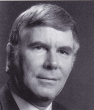
Sutter, Franz
1930 |
Graduate precision mechanic, head designer at Straumann AG, Waldenburg
To the tireless inventor and designer of surgical aids that allow doctors and dentists to help many patients to make their lives more worth living again. |
1988 |
|
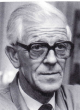
Cigada, Celestino
1925 - 1999 |
Precision mechanic, Institute of Physiology, University of Berne
Celestino Cigada, the inventive precision mechanic, who for more than 30 years has played a notable role in the design and development of experimental and measuring devices for research into life processes at cellular and sub-cellular level; who, confronted with a wide variety of technical problems, repeatedly finds solutions that he is able to translate into sophisticated precision apparatus. |
1988 |
|
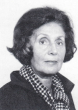
Spoerri, Elka
1924 – 2002 |
Art historian, Kunstmuseum Bern
The art historian who for over 20 years has taken exemplary care of the estate of the schizophrenic Bernese artist Adolf Wölfli and has made his work known worldwide through publications, lectures and exhibitions; who contributes to shedding light on the nature of creativity at the boundaries between health and illness, medicine and art history, the natural sciences and the humanities. |
1987 |
|
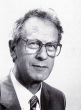
Spinnler, Kurt
1918 – 2001 |
Dipl. Mechanical Engineer ETH, retired Director of Vereinigte Rheinsalinen, Rheinfelden
To the tireless promoter of iodization and fluorination of table salt and thus the successful fight against goitre and tooth decay, the prudent pioneer of the intercantonal salt concordat, the liberalization of the Swiss salt trade and thus the optimal distribution of salt with prophylactic additives. |
1986 |
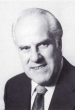
|
Burgdorfer, Willy
1925 |
Prof. Dr. phil. nat., Scientist Emeritus, Laboratory of Pathobiology, Rocky Mountain Laboratory, Hamilton, Mont., USA
The researcher of diseases transmitted to humans by blood-sucking arthropods and the discoverer of Borrelia burgdorferi, the causative agent of the worldwide spread tick-borne erythema migrans disease, a syphilis-like spirochete disease that affects various organ systems and causes severe polyarthritis and meningo-encephalitis. |
1986 |
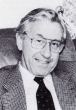
|
Traber, Hans A.
1921 – 1986 |
Freelancer for Swiss television, journalist, freelance filmmaker, Zürich
To the committed speaker and creator of masterful films about life in nature, who knows how to awaken in the viewer an understanding of and responsibility towards the habitats that surround him and thus also makes a significant contribution to public health. |
1985 |
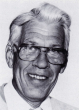
|
Nyman, Sture Rickard
1922 – 2002 |
Prof. Dr. med. dent., Faculty of Dentistry Gothenburg, Sweden
To the outstanding practitioner and scientist in the field of the biology of the masticatory system and the prevention and treatment of dental diseases, who has fundamentally investigated the regenerative potential of periodontal tissues in particular, to the inspiring teacher and generous colleague and to the selfless and tireless supporter of young Swiss clinicians and researchers in dentistry. |
1984 |
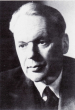
|
Blaschko, Hermann Karl Felix
1900 – 1993 |
Prof. Dr. med., Weiland Professor of Pharmacology, University of Oxford, England
To the important researcher in the field of biogenic amines, the pioneer of biochemical pharmacology and the co-creator and witness of major scientific developments and discoveries of our century. |
1983 |
|
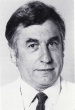
Stich, Hermann
1925 |
Technical Assistant at the Clinic for Dental Conservation, University of Bern
In recognition of his imaginative and selfless experimental, histological and microphotographic support of numerous research groups and young doctoral students, and in appreciation of his own scientific contributions to dentistry and its border areas. |
1983 |
|
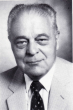
Keller, Max
1919 – 2003 |
First Secretary of the Department of Education of the Canton of Berne
To the prudent promoter of university causes who, thanks to his unwavering sincerity and great foresight, shaped the development of the Faculty of Medicine and the entire university in an atmosphere of mutual trust for two decades. |
1982 |
|
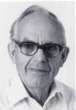
Trösch, Fritz
1907 – 1992 |
Primary school teacher, retired director of the Bernese sanatorium for alcoholic men, Kirchlindach BE
To the tireless promoter of prevention, care and aftercare for people at risk of addiction and addicts, who, as the longstanding director of the "Nüchtern" sanatorium for alcoholic men in Kirchlindach and as a member of cantonal and federal commissions, gained professional recognition beyond the country's borders, who sought to implement his own concepts in the care of addicts, who was significantly involved in the training of caregivers and who, through the organization of the "Aeschi Teaching Courses", put human, pharmacological, institutional and legal aspects of the problem of addiction up for discussion. |
1982 |
|
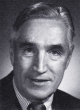
Wood, Earl Howard
1912 |
Prof. Dr. med. Emeritus Professor of Physiology, University of Rochester, Minn., USA
To the physiologist who used original methods to measure the influence of increased gravitational acceleration on the blood circulation and on the blood supply to the human brain, the tireless researcher on the way to three-dimensional radiological imaging of the movement of the heart and lungs. |
1982 |
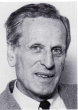
|
Frey, Ulrich
1918 – 2006 |
Dr. med., Director of the Federal Office of Public Health, Berne
The promoter of preventive medicine and health protection, the promoter of new concepts in the training of medical personnel, the successful representative of Swiss interests in international health policy. |
1981 |
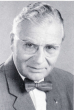
|
Hürny, Theo A.
1909 – 1984 |
Dr. med. dent., Dentist in Bern
The pioneer of preventive dentistry, who recognized early on in his practice that the problem of dental disease can only be solved through prevention. |
1981 |
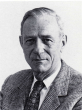
|
Rahn, Hermann
1912 – 1990 |
Dr. med., Professor of Physiology, State University of New York, Buffalo, N. Y., USA
To the teacher and researcher who has developed fundamental insights into respiratory function in humans and animals, particularly in relation to environmental conditions, thereby making a significant contribution to the foundations of clinical medicine and shaping global training in respiratory physiology through his example. |
1981 |
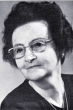
|
Meyer-Salzmann, Marta
1913 – 2006 |
Author of works on medical history, Zurich
An enthusiastic researcher of medical history in the Bernese Oberland, who, through tireless independent study, has masterfully researched and described the life and work of Michel Schüpbach, a surgeon from Langnau, and made the medical and cultural heritage of the Emmental region accessible to a wider audience. |
1980 |
|
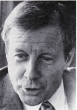
Kohler, François
1920 |
Dr. jur., Director of the Inselspital, Bern
In managing Inselspital, François Kohler placed great importance on partnership with the canton of Bern and collaboration with the university, doctors, nursing staff, administrative staff, and technical personnel. As a globally recognized hospital specialist, he created the ideal conditions for providing personalized care to patients and the best possible conditions for medical teaching and research. |
1980 |
|
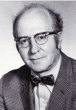
Engel George Libman
1913 – 1999 |
Prof. Dr. med., Professor Emeritus of Internal Medicine and Psychiatry, University of Rochester, Minn., USA
A pioneer in teaching and research who promoted a holistic understanding of sick people, thereby exerting a significant influence on the younger generation of doctors in various countries. |
1979 |
|
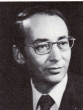
Giebisch, Gerhard Hans
1927 |
Dr. med., Prof. of Physiology, Yale University, New Haven, Conn., USA
The physiologist who used innovative methods to study the movement of salts and water in the kidneys, who in particular clarified the regulatory processes involved in maintaining a constant potassium concentration in blood plasma, and who has felt closely connected to our faculty for many years. |
1979 |
|
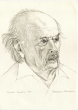
Hunziker, Heinrich
1879 – 1982 |
Doctor of Medicine, retired practicing physician
His research deepened understanding of the links between iodine deficiency and endemic goiter, and he played a key role in Switzerland becoming the first country in the world to introduce iodized salt as a preventive measure against endemic goiter. |
1978 |
|
Kretchmer, Norman
1923 – 1995 |
Prof. Dr. med., Director of the National Institute of Child Health and Human Development, Bethesda, Md., USA
The physician and researcher who developed fundamental scientific findings in developmental biology, enabled their application in practical medicine, and thereby promoted understanding of the causes and effects of developmental disorders in children, which is a prerequisite for their prevention and cure. |
1978 |
|
Orelli, Eduard von
1913 – 1999 |
Doctor of Chemistry, former head of the medical corps, retired colonel in the general staff, Bern
The military instructor who, through his personal commitment, trained generations of medical officers over many years, organized the further training of military doctors in military medicine and disaster relief, and played a decisive role in shaping the concept for the implementation of a coordinated medical service covering the entire country. |
1978 |
|
Monnier, Willy
1909 – 1981 |
Dr. jur. h. c., retired accountant at the Directorate General of Customs in Bern
The tireless and selfless helper who succeeded in creating a foundation dedicated to combating leprosy; the committed citizen who always took great care to ensure that donations collected by federal employees reached those who urgently needed our help; the philanthropist who, in the spirit of Dr. Albert Schweizer, helped to expand the leprosy station and treatment center in Lambarene, a relief organization with which the University of Bern feels a special connection through the work of its assistants and students. |
1977 |
|
Hadorn-Schläfli, Gertrud
1897 – 1985 |
Advocate, founder of the home care and home help organization of the Canton of Bern
The creator of home care and home help organizations in the city and canton of Bern, the energetic promoter of housing developments for people in need of care and the elderly, who, with her selfless, beneficial work at home and abroad, has made an exemplary and commendable contribution to alleviating the often hidden hardships of sick, frail, and lonely people, and whose life's work has brought about significant improvements in public welfare and health care. |
1977 |
|
Naef, Ulrich
1918 – 2003 |
Lic. jur., Assistant Secretary General of the Swiss Medical Association FMH
A lawyer who has been dealing with medical issues with exceptional dedication and energy for more than three decades, actively addressing the concerns of the Swiss Medical Association, student education and continuing medical education, thereby providing significant impetus for solving the serious problems facing the public health system, and for whom reform and coordination efforts in the field of medical student education are a genuine personal concern. |
1976 |
|
Fleury, Käthi
1919 |
Nurse, head of a leprosy clinic in Kathmandu
The nurse and development aid worker who fought against social misery and the isolation of lepers in Nepal and enabled numerous children of leprous parents to receive schooling, vocational training, and thus social integration. |
1976 |
 |
Ackerknecht, Erwin Heinz
1906 – 1988 |
Emeritus Professor of Medical History, University of Zurich
To the outstanding researcher and teacher of medical history, who has made a decisive contribution to the knowledge and understanding of the trial-and-error development of the fight against disease. |
1975 |
|
Ash, Major McKinley
1921 |
Prof. Dr. med. dent., University of Michigan, Ann Arbor, Mich. USA
To the selfless, outstanding teacher and scientist in the field of physiology and pathophysiology of the masticatory system, and the tireless promoter of young Swiss researchers in dentistry. |
1974 |
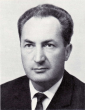
|
Mathys, Robert
1921 – 2000 |
Design engineer, mechanic, and owner of Mathys in Bettlach, Canton of Solothurn
Robert Mathys did not shy away from risking his economic livelihood by spending years working on the technical realization of a uniform set of bone surgery instruments, thereby enabling the clinical application of basic research conducted by doctors for the benefit of patients. With his original technical solutions, Mr. Mathys has made a significant contribution to the worldwide recognition and use of these instruments. |
1974 |
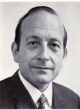
|
Weber, Walter
1927 – 2007 |
Preparator at the Anatomical Institute, University of Bern
To the expert in anatomical and histological methods, who through self-study has worked his way up to become an outstanding teacher of anatomy and, through his dedicated commitment, has earned the respect and admiration of his students. |
1973 |
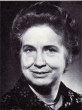
|
Bohren-Hoerni, Margrit
1917 – 1995 |
Dr. jur., Director of the Swiss Volksdienst Association, Zurich
The long-standing director of the Swiss Volksdienst Association, who, through the implementation of progressive ideas and the practical application of scientific findings, has helped many employees and students to enjoy healthy communal catering, thereby making a valuable contribution to the promotion of public health. |
1972 |
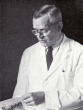
|
Töndury, Gian
1906 – 1985 |
Prof. Dr. med., Director of the Anatomical Institute, University of Zurich
In recognition of his exemplary and tireless commitment as a teacher and, in particular, his constant efforts to redesign anatomy teaching and integrate it into a human biology curriculum, through which he has made groundbreaking contributions to the reform of medical studies. |
1971 |
|
Søndergaard, Tyge
1914 – 1990 |
Prof. Dr. med., Head of the Thoracic Surgery Clinic, Aarhus University, Denmark
To the founder and tireless promoter of open heart surgery in Bern, the creator of ingenious and gentle new surgical procedures in the field of cardiac surgery, the exemplary physician. |
1971 |
|
Lauener, Paul
1887 – 1983 |
Doctor of Medicine, former school doctor for the city of Bern
For his constructive work as school doctor for the city of Bern, for his fundamental work on the physical and mental development of young people, for his preventive medical work in combating goiter and tuberculosis, and for his significant contributions to the Red Cross, the “Ferien und Freizeit” association for young people at Pro Juventute, and Pro Infirmis. |
1969 |
|
Katchalsky (Katzir-), Aharon
1914 – 1972 |
Prof. Dr. med., Dr. phil., Director of the Polymer Department, Weizmann Institute of Science, Rehovoth, Israel
Who, through his work on polyelectrolyte solutions, has created important models for biological processes, deepened our understanding of biological transport through the construction and interpretation of physicochemical transport systems, and, by introducing the thermodynamics of irreversible processes, has provided biologists working on transport issues with an important tool for interpreting the phenomena they observe. |
1969 |
|
König, Fritz
1900 – 1978 |
Doctor of Medicine, President of the Swiss Medical Association FMH, Lyss
In recognition of his many years of tireless and prudent service to the Swiss medical profession and his efforts to maintain a free, conscientious, and socially open medical profession, to promote medical education, and to foster fruitful cooperation between scientific and practical activities. |
1968 |
|
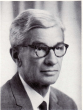
Schneider, Max
1904 – 1979 |
Doctor of Medicine, Professor of Physiology, Director of the Physiological Institute, University of Cologne
To the outstanding researcher in the field of blood supply to the brain. To the distinguished teacher who, with unflagging enthusiasm, made the latest findings in physiology accessible to doctors and medical students in both spoken and written form, who spent his youth in Bern and always remained loyal to our city. |
1968 |
|
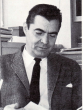
Palade, George Emil
1912 |
Professor of Cell Biology at Rockefeller University, New York Nobel Prize 1974
To the pioneer of electron microscopic cytology, who made the world of cell ultrastructure accessible and thus opened up a fruitful era of cell research with brilliant investigations into the structure and function of cells. |
1967 |
|
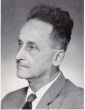
Bárány, Ernst
1910 |
Prof. Dr. med., Director of the Institute of Pharmacology, Uppsala University
Who, through his brilliant physiological and pharmacological research, has significantly advanced our understanding of the fluid dynamics of the eye. |
1967 |
|
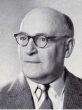
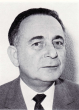
Beyeler, Otto
1902 – 1985 |
Teacher, Managing Director of Berner Wanderwege
For 30 years as President of Berner Wanderwege, he has done profound work in the areas of organization, cartography, and publishing to make the beauty of the canton of Bern accessible to the public, inspiring enthusiasm for increased physical activity and thus making a significant contribution to public health. |
1965 |
|
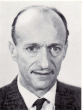
Plattner, Placidus Andreas
1904 – 1975 |
Prof. Dr. phil. nat., Head of Corporate Research at Hoffmann-La Roche & Co. AG, Basel
To whom medicine owes significant contributions to constitutional research and the synthesis of therapeutically important substances, and who continues to exert his influence in support of basic medical research and the promotion of young academics. |
1964 |
|
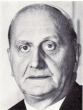
Kuffler, Stephen
1913 – 1980 |
Robert Winthrop, Professor of Neurophysiology and Neuropharmacology, Harvard University Medical School, Cambridge, Massachusetts, USA
To whom we owe a new approach to the nervous control of muscle contraction; who made the basic phenomena of spatial perception understandable by uncovering the organization of the receptive fields of the retina; who gave us new insights into the phenomenon of nervous inhibition. |
1962 |
|
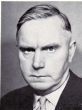
Schultze, Hermann Eduard
1899 – 1985 |
Dr. phil., Honorary Professor at the University of Marburg, Scientific Director of Behringwerke, Marburg
For his outstanding expertise in human blood proteins, enriching numerous trace proteins for the first time and characterizing them physicochemically and immunologically, thereby making a significant contribution to the diagnosis and treatment of blood protein disorders. |
1961 |
|
Leuthard, Franz
1903 – 1985 |
Prof. Dr. phil., Director of the Biochemical Institute, University of Zurich
To the successful researcher and teacher who, through his work on fructose and the enzymes involved in sugar breakdown, has made valuable contributions to the understanding and treatment of metabolic diseases. |
1960 |
|
Wander, Georg
1898 – 1968 |
Dr. sc. nat., President of Dr. A. Wander AG
In recognition of his outstanding contributions to the promotion of research and the creation of a memorial lecture series that brought guest lecturers to our university. His general interest in science has been reflected in his support for clinical research, which has benefited the entire field of medicine. |
1959 |
|
Hammer, Heinrich
1891 – 1972 |
Doctor of Medicine, Doctor of Dental Medicine, Professor of Dentistry, University of Kiel, Doctor of Dental Medicine honoris causa
In recognition of his work on transplantation and implantation in the dental and maxillofacial region and numerous other areas of dentistry, oral and maxillofacial medicine. |
1959 |
|
Békésy, Georg von
1899 – 1972 |
Prof. Dr. phil., Harvard University, Cambridge (Mass.), USA Nobel Prize 1961
For his fundamental research on the processes in the inner ear, which led to important theoretical and practical insights into energy conversion in the human ear canal. |
1957 |
|
Wald, George
1906 – 1997 |
Professor of Biology, Harvard University Medical School, Cambridge (Mass.), USA, Nobel Prize 1967
To the man who, with admirable perseverance and ingenious methods, researched the chemical structure of visual pigments, elucidated their formation and degradation in the eye, and thus enabled an understanding of the primary processes of vision. |
1955 |
|
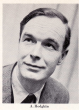
Hodgkin, Alan Lloyd, Sir
1914 – 1998 |
Dr., Professor of Physiology, University of Cambridge, Nobel Prize 1963
To the outstanding scientist whose work has given neurophysiology a new direction, and to the researcher who has traced the process of nerve excitation to measurable ion displacement. |
1954 |
|
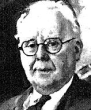
Platt, Harry, Sir
1886 – 1986 |
Dr med., Professor of Orthopaedics, University of Manchester
To Sir Harry Platt, the distinguished disciple of Sir Robert Jones, whose heritage he has not only administered with wisdom an forethought, but enriched with his own original and fruitful contributions. For the last forty years he has been in the vanguard of the imposing advance of Anglo-Saxon orthopaedic surgery, and has helped to bring this work to world-wide fame, thus achieving a task of great international and scientific value. Beyond the limits of his surgical research work, devoted principally to the traumatic lesions of the nerves and paralysis, congenital and acquired articular affections and bone diseases, he has distinguished himself as an eminent teacher and organizer, thus opening new ways for the development of Social Medicine. His life-work is the cornerstone in the important social-biological institutions without which a modern State would be unthinkable. |
1951 |
|
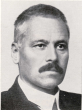
Fellenberg, Theodor von
1881 – 1962 |
Dr. phil., Head of the Chemical Laboratory, Federal Health Office, Bern
In recognition of his lifelong achievements in developing precise methods for determining medically and biologically important trace elements, vitamins, and nutrients. |
1950 |
|
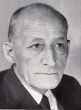
Christoffel, Hans
1888 – 1959 |
Doctor of Medicine, practicing psychiatrist, Basel
In recognition of his tireless research work as a practicing psychotherapist to promote the development of a realistic and comprehensive medical psychology. |